
“Why must I spend money on ISO 14001? We are not a mine. We do not pollute rivers. We have never had an inspector at the door.”
Owners of small and medium businesses ask me some version of this all the time. It is a fair question, and it deserves an honest answer rather than a sales pitch.
So here is the honest answer. If you see ISO 14001 as a certificate for the wall, do not do it. It will cost you time and money, and you will resent every audit. But if you see it as a structured way to understand the forces acting on your business, and to act on them before they act on you, it becomes one of the most useful strategic tools you can own.
The timing is also good. ISO 14001:2026 was published on 15 April 2026, and certificates against the 2015 edition lose their validity in April 2029 (DQS). If you are starting now, you start on the new edition, with no transition to plan for.
A different angle: ISO 14001 starts where strategy starts
Most articles about ISO 14001 open with the benefits:
- lower costs,
- better reputation,
- easier tenders.
They are all true, but they skip the more interesting point.
The very first requirement of ISO 14001, clause 4.1, asks you to determine the external and internal issues that are relevant to your purpose and that affect your ability to achieve the intended outcomes of your environmental management system. Clause 4.2 then asks who your interested parties are and what they need from you. Since the 2024 climate change amendment, now carried into the 2026 edition, you must also decide whether climate change is a relevant issue for your business.
Read that again. Before the standard asks you about waste, water or emissions, it asks you to look at your business the way a strategist does. In other words, it asks for a SWOT analysis with an environmental lens.
The SWOT, through an environmental lens
A SWOT is the simplest strategy tool there is. It looks at strengths and weaknesses inside the business, and at opportunities and threats outside it. Run one with environmental questions in mind, and a typical South African SME looks something like this:
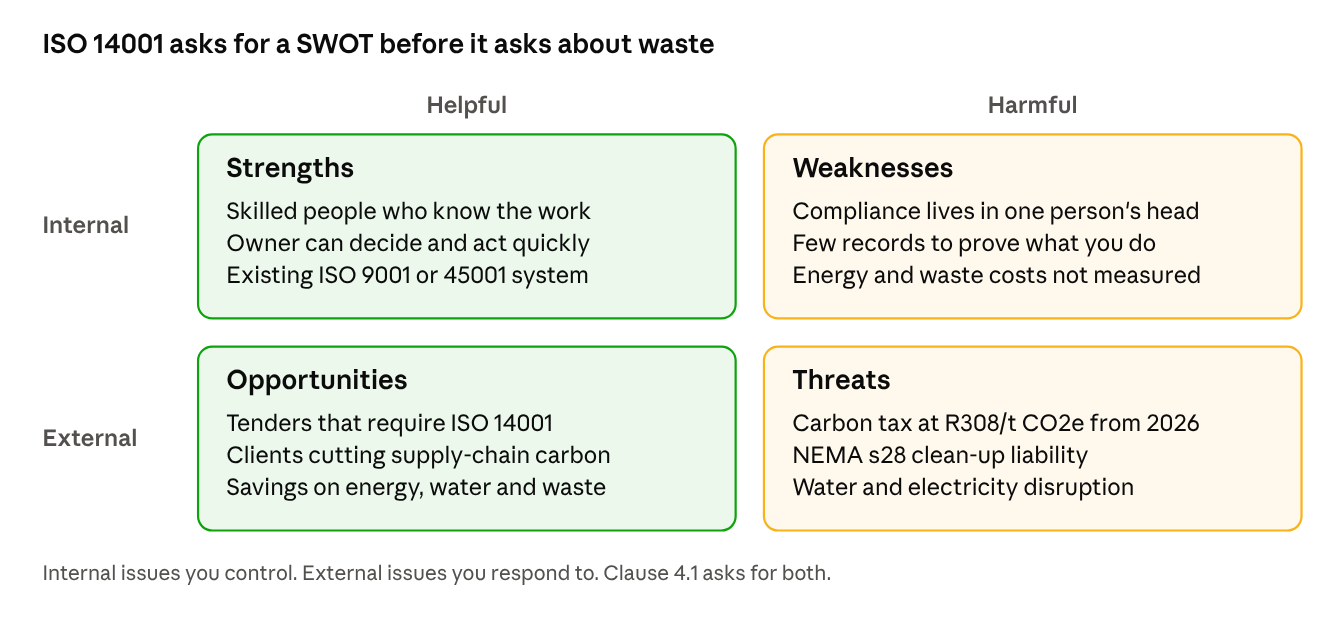
Your version will look different. That is the point. A manufacturer in Ekurhuleni, a logistics company in Durban, and a contractor working on a mine in Limpopo will each fill those four boxes differently, and each will need a different system. This is why a generic, off-the-shelf ISO 14001 manual so often fails at audit: it was written for someone else’s SWOT.
Internal and external issues: the forces you can control, and the ones you cannot
A SWOT splits the world in two. Strengths and weaknesses are internal: things inside your business that you control. Opportunities and threats are external: things in the market, the law and the environment that you do not control but must respond to. ISO 14001 uses the same split.
Here is how that looks for a typical South African SME:
| Issue | Internal or external | Why it matters in South Africa |
|---|---|---|
| Carbon tax | External | The rate rose from R236 to R308 per tonne of CO2e on 1 January 2026 (Cliffe Dekker Hofmeyr). |
| Climate law | External | The Climate Change Act 22 of 2024 took effect in March 2025 and provides for carbon budgets for large emitters (Greenplaces). If they are your customers, their carbon problem becomes your supplier questionnaire. |
| Environmental liability | External | NEMA section 28 places a duty of care on anyone who causes significant pollution or degradation, including a duty to pay for clean-up. |
| Water and energy supply | External | Water restrictions and unreliable electricity affect production, cost and continuity. |
| Customer and tender requirements | External | Large clients increasingly ask suppliers and contractors for ISO 14001 or equivalent evidence. |
| Owner and management time | Internal | When environmental compliance lives in one person’s head, the business is exposed when that person is away. |
| Staff competence and awareness | Internal | Spills, waste mix-ups and permit breaches usually start with someone who was never told. |
| Records and evidence | Internal | Without them, you cannot prove compliance to an inspector, a client or an insurer. |
None of these is exotic. Most businesses in this country face most of them. The difference between businesses is not whether these issues exist, but whether anyone has written them down and decided what to do about them.
How ISO 14001 turns a SWOT into action
A SWOT on its own is a workshop exercise. Most of them end up in a drawer. ISO 14001 is different because it will not let the analysis sit still. It links each issue to a chain of requirements, and an auditor will follow that chain:
- Issues and interested parties (clauses 4.1 and 4.2). You identify what affects you and what you are expected to deliver.
- Risks and opportunities (clause 6.1). Each issue becomes a risk to manage or an opportunity to take. Your environmental aspects, such as energy use, waste and emissions, and your compliance obligations are assessed here too.
- Objectives (clause 6.2). The important risks and opportunities become measurable targets, with an owner, resources and a deadline.
- Operational control (clause 8). The way work is actually done changes to meet those targets.
- Monitoring, internal audit and management review (clause 9). Top management reviews the results, assesses whether issues have changed, and decides what to do next.
- Improvement (clause 10). When something goes wrong, you fix the cause, not just the symptom.
This is what makes the system worth having. A weakness that was once a vague worry becomes an objective with a name next to it. A threat such as rising carbon costs becomes a measured energy-reduction target. An opportunity such as a tender requirement becomes a market you can now enter.
And every year, management review forces you to ask the strategic question again: has anything changed?
Why go through certification at all?
Here is something many consultants will not tell you: you can implement ISO 14001 without ever being certified. If the system improves how you run your business, it has already paid its way.
So why go further? Because a system you say you have is a claim. A system an independent auditor has verified is evidence. That difference matters to three groups of people:
- Customers and tender panels cannot audit every supplier themselves. An accredited certificate lets them rely on someone else’s audit.
- Regulators and insurers look more kindly on a business that can show a functioning, independently audited system when something goes wrong.
- You. An external audit every year keeps the system alive. Without that discipline, most systems quietly decay.
One warning. Not every certificate is equal. In South Africa, SANAS, the national accreditation body, accredits certification bodies and is a signatory to the International Accreditation Forum’s mutual recognition arrangement. A certificate from an unaccredited body may be cheaper, but a serious client may not accept it. Always ask your certification body for its SANAS accreditation number and scope before you sign.
Coming next: looking further outside
A SWOT tells you that external threats and opportunities exist. It does not give you a structured way to find them all. In the next article, I will take apart the external half of the picture, force by force: a STEEPLE analysis of the social, technological, economic, environmental, political, legal and ethical pressures on South African businesses. Ethics is the letter most analyses leave out, and it is the one your clients, lenders and employees increasingly judge you on. I will show why each of the seven is a reason to have a working environmental management system.
Not sure where your business stands? Let’s talk for 15 minutes
In a 15-minute call, I will ask you a few questions about your business, your clients and your sector, and tell you honestly whether ISO 14001 is worth it for you right now. Sometimes the answer is “not yet”, and I will tell you that too. There is no sales pitch and no obligation. We implement the system, and an independent, accredited certification body audits and certifies it.
About the author. Dr Andreas B Burger is the founder of SHEQ4SME (Pty) Ltd and Andreas Burger Consulting (Pty) Ltd. He holds an MBA, MPhil and a DBA, the NEBOSH International Diploma and SAMTRAC, and is an ISO 9001 and ISO 45001 Lead Auditor. He builds integrated management systems for South African businesses.
Sources
- ISO 14001:2026 Environmental management systems: Requirements with guidance for use
- Cliffe Dekker Hofmeyr: Carbon tax, some developments (February 2026)
- Greenplaces: Climate Change Act 22 of 2024
- DQS: ISO 14001:2026 transition
- National Environmental Management Act 107 of 1998 (section 28, duty of care)
- Carbon Tax Act 15 of 2019; Climate Change Act 22 of 2024
- National Environmental Management: Waste Act 59 of 2008; National Water Act 36 of 1998