In the previous article, we ran a SWOT analysis through an environmental lens. It showed that every South African business faces external threats and opportunities. What a SWOT cannot do is make sure you have found them all. It tends to capture whatever is worrying the people in the room that day.
This article closes that gap. We are going to walk outside your gate and look at seven forces, one at a time. None of them asks your permission. All of them are already moving. And each one, as you will see, is a reason why a working environmental management system is no longer a nice-to-have.
STEEPLE: PESTLE with a conscience
Most managers know PESTLE: political, economic, social, technological, legal and environmental. It is a long-established way of scanning the world outside a business. STEEPLE adds a seventh letter, ethical, and changes the order of the letters. Business schools increasingly teach it because the six classic forces leave a gap. They describe what is happening around you, but not what your customers, lenders and employees think is right.
Here is why this matters for ISO 14001. Clause 4.1 of ISO 14001:2026 asks you to determine the external issues that affect your environmental management system. The standard does not tell you how to find them. STEEPLE gives you a disciplined way to do so, and an auditor who sees one has evidence that you looked properly.
The seven forces, South African edition
Each force below is real, current and documented. The third column shows where ISO 14001 gives you a structured response.
| Force | What is happening now | How ISO 14001 responds |
|---|---|---|
| Social | Communities, employees and consumers expect businesses to be good neighbours. Water, dust, noise and waste are local issues, and complaints travel fast on social media. | Clause 4.2 interested parties and clause 7.4 communication: you know who expects what, and you can show how you respond |
| Technological | Rooftop solar, batteries, low-cost sensors and digital records have made it cheaper to measure and reduce energy, water and waste. | Clause 9.1 monitoring and measurement: data you can act on and prove, instead of estimates |
| Economic | Eskom tariffs rose 8.76% for direct customers on 1 April 2026 and 9.01% for municipalities on 1 July 2026, with 8.83% approved for April 2027 (Engineering News). | Clause 6.2 objectives: energy and resource use become measured targets, and the savings fund the system |
| Environmental | Water scarcity, heat and extreme weather are no longer future scenarios. They disrupt production, logistics and supply chains now. | Clause 4.1 climate change consideration and clause 8.2 emergency preparedness: you plan for disruption instead of reacting to it |
| Political | The EU’s Carbon Border Adjustment Mechanism entered its definitive phase on 1 January 2026. The share of embedded emissions that must be covered rises from 2.5% in 2026 to 100% by 2034 (Werksmans). Even if you do not export, your exporting customers will ask for your data. | Clause 8.1 life cycle perspective and supplier control: you can answer the carbon questions your customers will ask |
| Legal | NEMA section 28 imposes a duty of care and clean-up costs. NEMA section 34(7) can hold directors and managers personally liable for certain environmental offences. Carbon tax stands at R308 per tonne of CO2e from 2026. | Clause 6.1.3 compliance obligations and clause 9.1.2 evaluation of compliance: you know which laws apply and can prove you meet them |
| Ethical | King V took effect for financial years from 1 January 2026, framing governance as ethical, effective leadership (HSF Kramer). Unsupported “green” claims expose you under the Consumer Protection Act’s rules on misleading representations. | Clause 5 leadership and clause 9.3 management review: commitments are made at the top and checked against evidence |
Read down the third column. Every force, from community expectations to carbon tax, has a home in the standard. That is not a coincidence. ISO 14001 was written to be a system for responding to exactly this kind of external pressure.
The forgotten E: why ethics is the hardest force to fake
The other six forces can, in principle, be handled by compliance alone. You pay the tax, meet the permit condition and file the report. Ethics is different. It is about whether what you say matches what you do when nobody is checking.
The standards world has noticed. ISO 9001:2026, published on 16 September 2026 (LRQA), builds quality culture and ethical behaviour into its leadership requirements. In South Africa, King V describes corporate governance as ethical, effective leadership. Although King V is voluntary for most organisations, South African courts treat King principles as part of generally accepted governance practice (Mondaq).
For environmental management, the ethical test is usually the gap between the brochure and the yard. A website that says “we care for the environment” next to an overflowing skip and an unbunded diesel tank is not a marketing problem. It is an ethical one, and in front of the wrong client, a commercial one.
This is where an independently audited ISO 14001 system earns its keep. It turns environmental claims into commitments that someone outside the business has checked against evidence. That is the difference between saying you are responsible and being able to prove it.
A scan is a snapshot. A system is a habit.
The weakness of any STEEPLE exercise is the same as a SWOT: done once, it starts going stale the day it is filed. Tariffs change, laws are gazetted, customers rewrite their supplier requirements.
ISO 14001 solves this by building the scan into a cycle. Management review must consider changes in external and internal issues, so the question “has anything changed?” is asked at least once a year, by the people who can act on the answer.
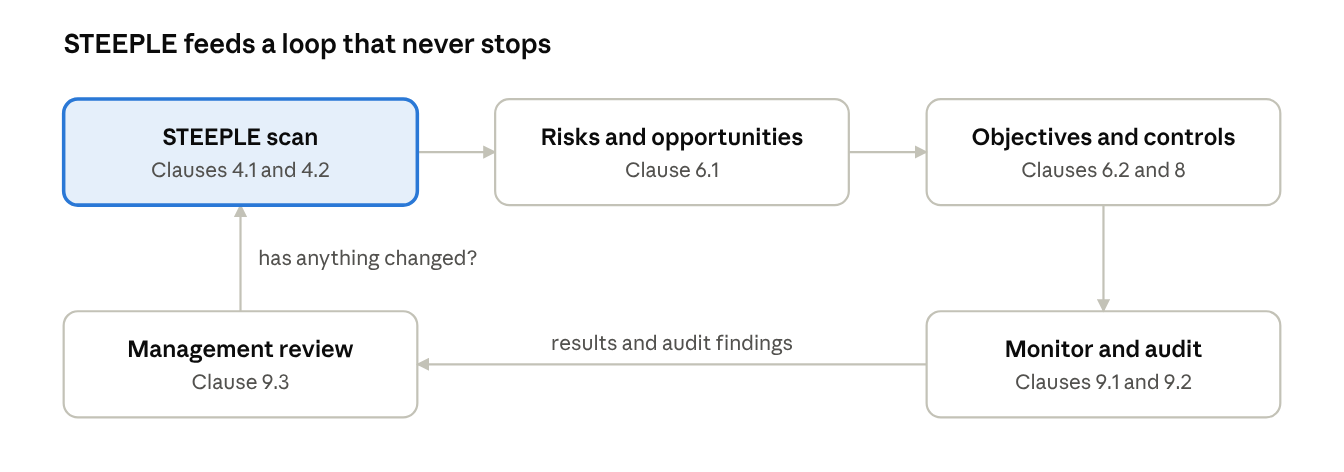
The value is not in the analysis itself. It is in the loop: each scan feeds decisions, each decision is measured, and the results feed the next scan. A business that runs this loop honestly is rarely surprised by the forces outside its gate.
The short version
Across this series, we have asked one question: why should a business go to the trouble of implementing and certifying ISO 14001? The answer is not “because a client asked”, although they often do. The answer is that the forces outside your gate are real, they are moving, and they will shape your business whether you plan for them or not. ISO 14001 is a proven, internationally recognised way to plan for them, and a certificate proves to others that you have.
Want to see your own seven forces? Let’s talk for 15 minutes
In a 15-minute call, I will ask you about your sector, your clients and your sites, and point out the two or three external forces most likely to affect your business in the next year. You will leave with a clearer picture of whether or not ISO 14001 is the right next step. There is no sales pitch and no obligation. We implement the system, and an independent, accredited certification body audits and certifies it.
About the author. Dr Andreas B Burger is the founder of SHEQ4SME (Pty) Ltd and Andreas Burger Consulting (Pty) Ltd. He holds an MBA, MPhil and a DBA, the NEBOSH International Diploma and SAMTRAC, and is an ISO 9001 and ISO 45001 Lead Auditor. He builds integrated management systems for South African businesses.
Sources
- ISO 14001:2026 Environmental management systems: Requirements with guidance for use; ISO 9001:2026 Quality management systems: Requirements
- LRQA: ISO 9001:2026 is live; the transition period has begun
- Engineering News: NERSA approves higher electricity hikes for 2026/27
- Werksmans: South African exporters, take note (CBAM)
- HSF Kramer: King V, the new blueprint for corporate resilience
- Mondaq: King V launched in South Africa
- National Environmental Management Act 107 of 1998 (sections 28 and 34); Carbon Tax Act 15 of 2019; Climate Change Act 22 of 2024; Consumer Protection Act 68 of 2008