
Let me say out loud what many South African business owners say only in private.
It is hard to talk about ethics in this country without a bitter laugh. We pay our taxes, file our returns and keep our permits current. Then we watch commission after commission expose corruption, while very few of the people named in those reports ever stand in a dock. It is demoralising. Why should a small business hold itself to a higher standard than the people who make and enforce the rules?
This article is my answer. In the previous article, we used a SWOT to look inside the business. Here we walk outside the gate and look at seven external forces using a framework called STEEPLE. Six of those forces you can only respond to. The seventh, ethics, is different. It is the one force where you do not have to wait for anyone else to get it right. That is where we will spend most of our time.
STEEPLE: PESTLE with a conscience
Most managers know PESTLE: political, economic, social, technological, legal and environmental. It is a long-established way of scanning the world outside a business. STEEPLE adds a seventh letter, ethical, and changes the order of the letters. Business schools increasingly teach it because the six classic forces leave a gap. They describe what is happening around you, but not what your customers, lenders and employees think is right.
Here is why this matters for ISO 14001. Clause 4.1 of ISO 14001:2026 asks you to determine the external issues that affect your environmental management system. The standard does not tell you how to find them. STEEPLE gives you a disciplined way to do so, and an auditor who sees one has evidence that you looked properly.
The seven forces, South African edition
Each force below is real, current and documented. The third column shows where ISO 14001 gives you a structured response.
| Force | What is happening now | How ISO 14001 responds |
|---|---|---|
| Social | Communities, employees and consumers expect businesses to be good neighbours. Water, dust, noise and waste are local issues, and complaints travel fast on social media. | Clause 4.2 interested parties and clause 7.4 communication: you know who expects what, and you can show how you respond |
| Technological | Rooftop solar, batteries, low-cost sensors and digital records have made it cheaper to measure and reduce energy, water and waste. | Clause 9.1 monitoring and measurement: data you can act on and prove, instead of estimates |
| Economic | Eskom tariffs rose 8.76% for direct customers on 1 April 2026 and 9.01% for municipalities on 1 July 2026, with 8.83% approved for April 2027 (Engineering News). | Clause 6.2 objectives: energy and resource use become measured targets, and the savings fund the system |
| Environmental | Water scarcity, heat and extreme weather are no longer future scenarios. They disrupt production, logistics and supply chains now. | Clause 4.1 climate change consideration and clause 8.2 emergency preparedness: you plan for disruption instead of reacting to it |
| Political | The EU’s Carbon Border Adjustment Mechanism entered its definitive phase on 1 January 2026. The share of embedded emissions that must be covered rises from 2.5% in 2026 to 100% by 2034 (Werksmans). Even if you do not export, your exporting customers will ask for your data. | Clause 8.1 life cycle perspective and supplier control: you can answer the carbon questions your customers will ask |
| Legal | NEMA section 28 imposes a duty of care and clean-up costs. NEMA section 34(7) can hold directors and managers personally liable for certain environmental offences. Carbon tax stands at R308 per tonne of CO2e from 2026. | Clause 6.1.3 compliance obligations and clause 9.1.2 evaluation of compliance: you know which laws apply and can prove you meet them |
| Ethical | King V took effect for financial years from 1 January 2026, framing governance as ethical, effective leadership (HSF Kramer). Unsupported “green” claims expose you under the Consumer Protection Act’s rules on misleading representations. | Clause 5 leadership and clause 9.3 management review: commitments are made at the top and checked against evidence |
Read down the third column. Every force, from community expectations to carbon tax, has a home in the standard. That is not a coincidence. ISO 14001 was written to be a system for responding to exactly this kind of external pressure.
The forgotten E: the honest picture
A serious article about ethics has to start with the facts, not with outrage. The facts are bad enough.
Perception. South Africa scored 41 out of 100 on Transparency International’s 2025 Corruption Perceptions Index, unchanged for three years and below the global average of 42 (Corruption Watch).
State capture. The Zondo Commission implicated close to 1,500 people. Of its 218 criminal investigation recommendations, only about a fifth had been finalised or enrolled for trial, and four cases had produced guilty verdicts (Mail & Guardian). In October 2026, former Chief Justice Zondo said he was disappointed that the mechanisms recommended to prevent a repeat had not been implemented (IOL).
The criminal justice system itself. The Madlanga Commission was established in July 2025 to investigate criminality, political interference, and corruption in the criminal justice system (Daily Maverick). Its final report is due on 16 November 2026 (allAfrica).
Fairness requires the other side too. Investigations flowing from Zondo have recovered more than R16 billion in stolen assets and unpaid taxes, and a former MP was sentenced to seven years in March 2026 (Daily Maverick). South Africa left the FATF grey list in 2025 (BusinessTech). The Madlanga process has moved faster, with arrests and suspensions while hearings were still running.
But notice something. Every one of those improvements came from individuals inside institutions who decided to do their jobs properly. That is the lesson for business. Systems do not become ethical on their own. People make them so.
It rises and falls on leadership
John C. Maxwell’s best-known line is that “everything rises and falls on leadership.” He wrote it about organisations of every kind, and South Africa’s public sector shows what happens when it goes the wrong way.
The same principle works in your favour inside your own business. Your staff do not learn ethics from your policy manual. They learn it from what you do when a client offers cash for a “small favour”, when an inspector hints that a problem could go away, or when a load of waste would be cheaper to dump than to dispose of properly. In each case, the owner sets the ceiling. Nobody in the business will consistently behave better than the person at the top.
That is uncomfortable, but it is also empowering. You cannot fix the state. You can decide, today, what standard your business keeps.
The Stoic road
The Stoic philosophers lived under emperors who were often far worse than anything we face today. Marcus Aurelius ran an empire through war and plague. Epictetus was born into slavery. Their philosophy was not a retreat from a corrupt world. It was a practical method for living well inside one.
Its foundation is what Epictetus called the dichotomy of control. Some things are up to us: our judgements, our choices and our actions. Everything else is not. The Stoic does not waste energy raging at what cannot be changed. They put all of it into what they can.
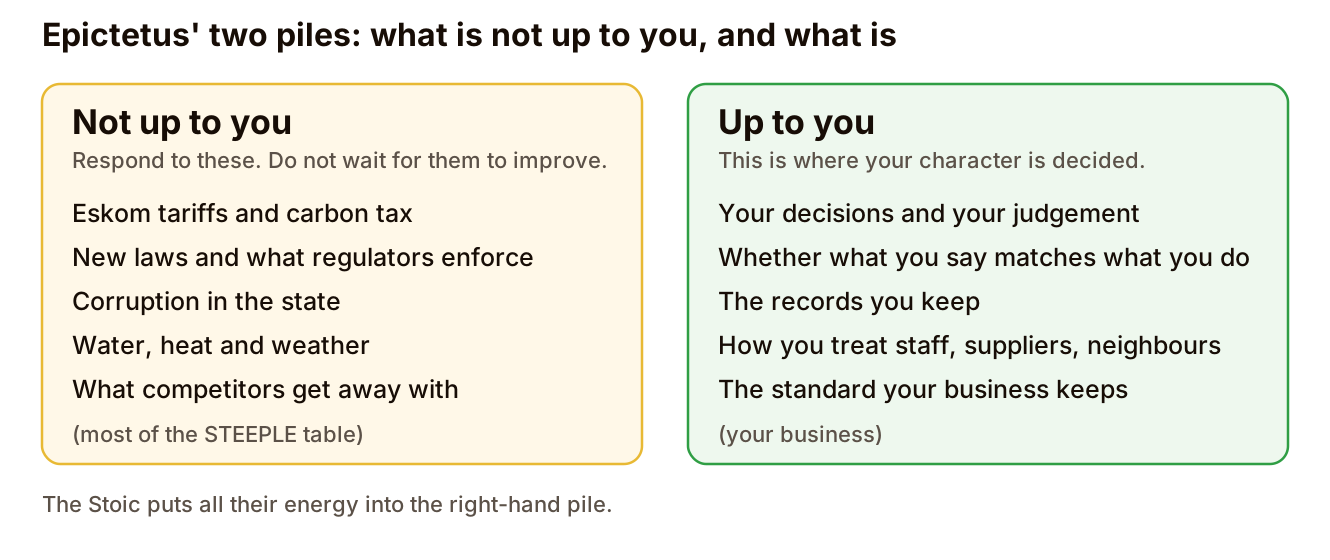
Look at the left-hand pile. It is most of the STEEPLE table above. Look at the right-hand pile. It is your business. The Stoics would say your character is decided entirely by the right, no matter how bad the left gets.
The Stoics also named four virtues. Each one translates directly into a business decision:
| Virtue | What it means | What it looks like in your business |
|---|---|---|
| Wisdom | Seeing things as they are | Basing decisions on evidence and records, not on assumptions or what others get away with |
| Justice | Treating others fairly | Paying suppliers on time, treating staff fairly and not passing pollution on to your neighbours |
| Courage | Doing right when it costs you | Refusing the bribe, walking away from the dirty tender, reporting what the law requires you to report |
| Temperance | Self-control and moderation | Not overpromising, not cutting corners to win this month’s order, and building for the long term |
In his Meditations, Marcus Aurelius told himself to stop debating what a good man should be and be one. That is the challenge for every owner reading this. Not to complain more eloquently about the state, but to run a business that would embarrass it by comparison.
Ethics is no longer optional: it has teeth
If the moral argument does not persuade you, the legal one should. The law has moved, and it now reaches into private businesses of every size.
Duty to report (PRECCA section 34). Anyone in a position of authority who knows or reasonably suspects corruption, fraud, theft or extortion of R100,000 or more must report it to the Hawks. Failing to report is itself an offence.
Failure to prevent (PRECCA section 34A). Since 3 April 2024, a business can be held liable when its “associates”, including employees, agents and subcontractors, act corruptly on its behalf. The only defence is to prove that adequate procedures were in place to prevent corruption (Bizcommunity).
What is coming. The PRECCA Amendment Bill (B19-2026), a private member’s bill tabled in Parliament in July 2026, proposes lowering the reporting threshold from R100,000 to R30,000 and doubling the fine for failing to report to R500,000 (PMG). It is not yet law.
Governance. King V, effective for financial years from 1 January 2026, describes governance as ethical, effective leadership. It is voluntary for most organisations, but South African courts treat King principles as part of generally accepted governance practice (Mondaq).
Read section 34A carefully. The law no longer accepts an owner who says, “I didn’t know”. It asks what procedures you had in place. That is management-system language.
This is where the ISO family earns its place. ISO 37001 is the international standard for anti-bribery management systems, and it is one recognised way of showing that adequate procedures exist. ISO 14001 and ISO 45001 require top management to take accountability for their systems. ISO 9001:2026, published in September 2026, builds ethical behaviour into its leadership requirements. They share the same structure so that you can run them as one integrated system rather than four separate projects.
Rethinking your strategy: integrity as a competitive advantage
Here is the strategic point most owners miss. In a low-trust environment, trust becomes scarce, and scarce things are valuable. When buyers cannot assume that suppliers are honest, the supplier who can prove it stands out. Large clients, lenders and international customers are actively looking for partners whose environmental, safety and ethical claims hold up under audit.
So the Stoic road is not only the right road. It is a market position. Before you next sit down to plan, ask yourself five questions:
- If a journalist followed my business for a month, what would I be embarrassed to see in print?
- Which of my environmental or safety claims could I prove tomorrow, with records, to a sceptical auditor?
- Do my staff, agents and subcontractors know what I expect when someone offers or asks for a bribe, and do they know I will back them?
- Am I waiting for the government, the municipality or my competitors to behave better before I do?
- If the answer to the last question is yes, what is that waiting costing me?
None of these questions needs a consultant to answer. They need honesty, and the courage to act on what you find.
A scan is a snapshot. A system is a habit.
The weakness of any STEEPLE exercise is the same as a SWOT: done once, it starts going stale the day it is filed. Tariffs change, laws are gazetted, customers rewrite their supplier requirements.
ISO 14001 solves this by building the scan into a cycle. Management review must consider changes in external and internal issues, so the question “has anything changed?” is asked at least once a year, by the people who can act on the answer.
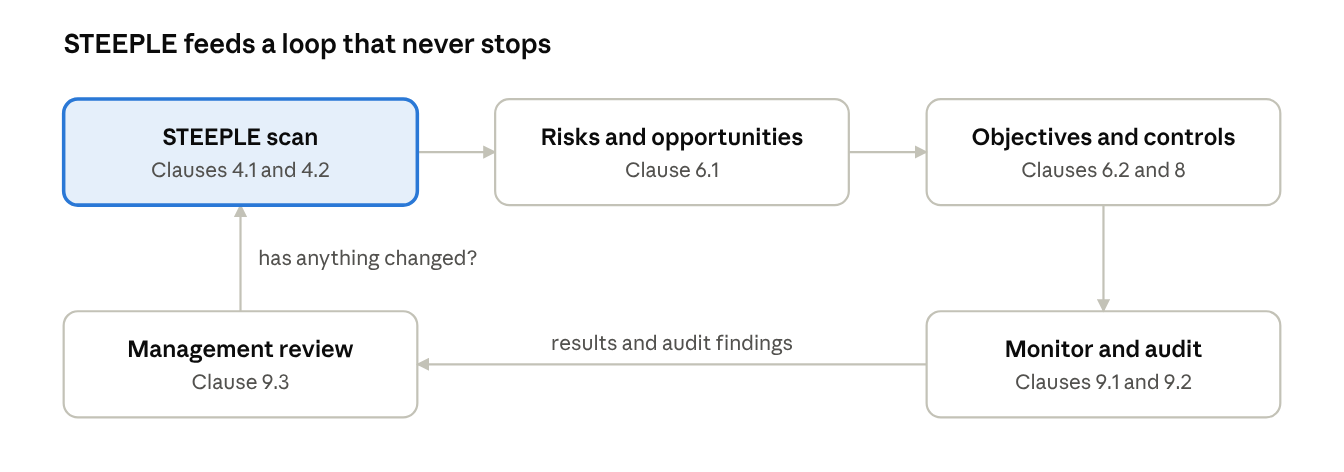
The value is not in the analysis itself. It is in the loop: each scan feeds decisions, each decision is measured, and the results feed the next scan. A business that runs this loop honestly is rarely surprised by the forces outside its gate.
The short version
Across this series, we have asked why a business should implement and certify ISO 14001. The SWOT showed the forces inside your business. STEEPLE shows the forces outside it, and six of the seven are beyond your control. The seventh is not. When public institutions fail the ethics test, a business that passes it, and can prove it, stands out. ISO 14001, integrated with other ISO management system standards, turns good intentions into commitments an independent auditor has verified. That is the Stoic road in practice: control what is yours, and do it so well that it shows.
Ready to take the different road? Let’s talk for 15 minutes
In a 15-minute call, I will ask you about your sector, your clients and your sites, and point out the two or three external forces most likely to affect your business in the next year. You will leave with a clearer picture of whether or not ISO 14001 is the right next step. There is no sales pitch and no obligation. We implement the system, and an independent, accredited certification body audits and certifies it.
About the author. Dr Andreas B Burger is the founder of SHEQ4SME (Pty) Ltd and Andreas Burger Consulting (Pty) Ltd. He holds an MBA, MPhil and a DBA, the NEBOSH International Diploma and SAMTRAC, and is an ISO 9001 and ISO 45001 Lead Auditor. He builds integrated management systems for South African businesses.
Sources
- ISO 14001:2026 Environmental management systems: Requirements with guidance for use; ISO 9001:2026 Quality management systems: Requirements
- LRQA: ISO 9001:2026 is live; the transition period has begun
- Engineering News: NERSA approves higher electricity hikes for 2026/27
- Werksmans: South African exporters, take note (CBAM)
- HSF Kramer: King V, the new blueprint for corporate resilience
- Mondaq: King V launched in South Africa
- National Environmental Management Act 107 of 1998 (sections 28 and 34); Carbon Tax Act 15 of 2019; Climate Change Act 22 of 2024; Consumer Protection Act 68 of 2008
- Corruption Watch: CPI 2025, South Africa’s performance unchanged
- Mail & Guardian: No procurement watchdog body yet, four years past State Capture report
- IOL: Zondo disappointed key recommendations remain unimplemented
- Daily Maverick: Zondo exposed the corruption; now Madlanga is closing the net
- Daily Maverick: Ramaphosa appoints special task team after Madlanga interim findings
- allAfrica: Madlanga Commission gets more time to root out corruption
- BusinessTech: South Africa on the wrong side of corruption (FATF grey list exit)
- Bizcommunity: Inside the PRECCA Amendment Bill
- PMG: PRECCA Amendment Bill B19-2026
- Prevention and Combating of Corrupt Activities Act 12 of 2004 (sections 34 and 34A); ISO 37001 Anti-bribery management systems
- John C. Maxwell, Developing the Leader Within You; Epictetus, Enchiridion; Marcus Aurelius, Meditations